A portrait is a painting with something wrong with the mouth.
– John Singer Sargent (1856-1925)
 (Sojourner Truth from Pinterest)
We hope that artists pre-dating photography were really good at their art and had some sense of historic integrity—that Gilbert Stuart caught Dolley Madison’s early 19thcentury likeness and Washington’s army really did get horses onto those small boats crossing the Delaware as Emanuel Leutze suggests. We have to believe that Leonardo was pretty accurate with the Mona Lisa, right? Many of us find those images dear, fascinating—close to time travel.
Then came photography—arguably developed (ugh) between 1826 and 1839 and we get to see brief moments in the lives of Sojourner Truth, William Bonney, aka Billy the Kid and Frederick Douglass, prophet of freedom.
So, why images stashed in shoe boxes beneath our beds? Albums filled with first birthdays, grade school concerts, Nana’s picnic, Tyrone’s first car, Uncle Viv in Aunt Bobbi’s bra—some snapshots in duplicate and triplicate? The more organized among us have dated and neatly stashed albums covering (typically) three or four generations’ mostly mundane, rarely profound meanderings (“For future generations.”).
Then came Instagram! Whoo-boy, and look what I’m having for lunch!
 Imagine two sisters from the same parents: one sister brunette, the other blond. They arrive on the West Coast and one settles in The North, the other in The South. One is surrounded by Redwoods, fern grottos and flannel-wrapped nomads, the other strolls barefoot in the mornings’ cool sands shaded by date palms along an endless surf. Independent of the other, each chooses two-and-three-dimensional visual art as the language of her soul, and this evening we admire the similarities as well as the differences in their expressions. These representative pieces reflect past work—lasting, timeless and created under a different sky.

 Intimidating parked next to any of the current satellite-tracked and climate-controlled livery, it floats there like The Enterprise next to the mailbox where Kev parked it. Pointed uphill, its rear end lifted in a slight California slant on bead-blasted mags, it sits level. When Kev leaves tonight, the pie-plate headlights will come on slowly, like they take time to warm up. In new, stock condition, it would have been a knockout on a showroom floor in 1975. Low, block-long and jeweled opulence rivaling the Caddies, Lincolns and Monte Carlos of the day—its hood-to-trunk ratio is three-to-one. Monster V-eight, dual exhaust, race-proven torque-flight transmission, door-post carriage lights and a trunk that could hold three disagreeable guys from New Jersey. Ricardo Montalban (“The plane, the plane!”) gave television voice to the Cordoba experience pointing out one unique feature: “…soft Corinthian leather.”
 The bridge from Blues to Rock & Roll was crossed in 1945 when Little Walter, frustrated by his harmonica being drowned out by amplified guitars, employed a small palm mic with which he could stand toe-to-toe with the other instruments. And, he took it one step further pushing the amp to eleven and creating a sound never-before heard. Little Walter invented the harmonic distortion fuzz that went on to serve the greats who followed including Jimi Hendrix. In 2008, Little Walter was posthumously inducted to the Rock & Roll Hall of Fame and he would have looked great at the ceremony in his suit and two-toned shoes.
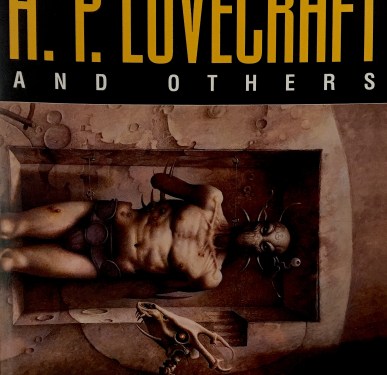 And if Howard Phillip Lovecraft could only see us now. Just eighty-some years later – the Mars rover, Hubble images, full-color portraits of black holes, stem cells, 23andMe. He’d probably ask, “Interesting, but show me that little telephone again?”
 HJ Brennan